Showing posts with label Online. Show all posts

Totality and Victory

Total Solar Eclipse of 11 July 2010

FIFA 2010 World Champions - Spain

Above two images definitely sums up everything happened yesterday - Sunday 11 July 2010 - and it was one of those days you completely rely on technology and be thankful about it. Being able to watch two amazing events, FIFA 2010 Finals and the Total Solar Eclipse via internet simultaneously and share it with others was a great experience.

A total solar eclipse occurs when the moon passes between the sun and the Earth, blocking its rays and casting a shadow. The eclipse took place on the 11 July 2010 followed an 11,000km (6.900-mile) path over the South Pacific. The longest time of eclipse - five minutes and 20 seconds - was over the sea.

It's reported that some 5000 astronomers were spread out across the atolls of French Polynesia catch this spectacular solar eclipse. And few among this group took the extra effort to web-stream the Eclipse online for the rest of the world to watch!

As an effort to expand their outreach, I contacted few eclipse chasers, researched more and compiled a list of web-streams to one place, so everyone can easily access. This effort was publicized via Facebook, Twitter and other email groups. Should note that many of my twitter and facebook friends did a great job by sharing it with more people.

The first live web stream came via a group from Wakayama University at Hao (French Polynesia). Below are some screen captures from their web stream.


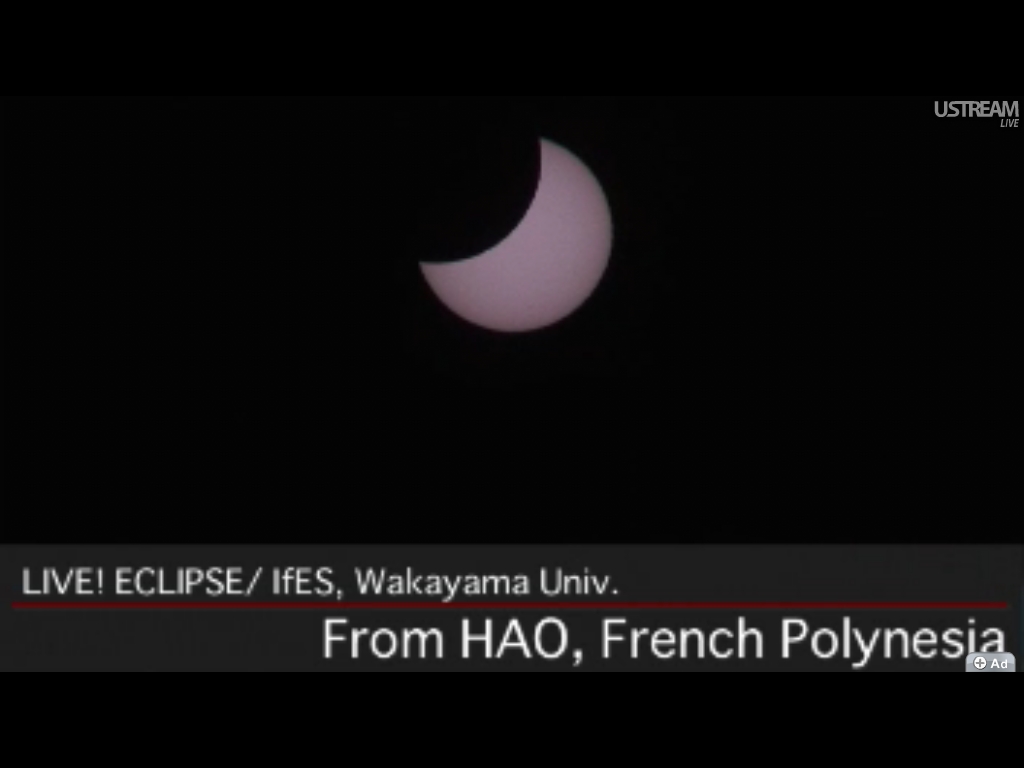


Few minutes into the Totality it got clouded and Wakayama web-stream went off line. Then a group called Shelios started a web-stream. Below are some screen captures from their web-stream.


During the 5-hour event, sky watchers spent as much as 4 minutes completely enveloped in the Moon's shadow watching in awe as the solar corona revealed itself to the human eye.

As soon as the eclipse ended, photos started pouring in, and it was a well treat for everyone. Below are some of the best images available up to now ( 5:30UT 12 July 2010). Enjoy!


Photo by Donald Gardner (Atoll de Hao, French Polynesia)

Photo by Donald Gardner (Atoll de Hao, French Polynesia)

Photo by Donald Gardner (Atoll de Hao, French Polynesia)

Photo by Donald Gardner (Atoll de Hao, French Polynesia)

Photo by Constantinos Emmanouilidis (Mangaia, Cook Islands)

Photo by AFP (Martin Bernetti)

Photo by Bill Kramer (Paul Gauguin - South of Tahiti)

Photo by Alson Wong (Paul Gauguin - South of Tahiti)

Photo by Alson Wong (Paul Gauguin - South of Tahiti)

Photo by Alson Wong (Paul Gauguin - South of Tahiti)

Photo by Stefan Krause from El Calafate-Argentina

Shelios expedition crew after the Eclipse and celebrating the Spain victory


It was a fantastic Sunday with the Total Solar Eclipse and the FIFA 2010 finals. If you missed the eclipse live feed, check the below video complied by Reuters.


First video from Reuters


Image: above images are copyrighted by the respective photographer.

Watch Live Webcast of ESA's Rosetta Flyby of Asteroid Lutetia - 10 July 2010


On 10 July, ESA's Rosetta spacecraft will fly past 21 Lutetia, the largest asteroid ever visited by a satellite. After weeks of manoeuvres and a challenging optical navigation campaign, Rosetta is perfectly lined up to skim by at 3162 km (2000 miles). This event will be live webcasted by ESA at 16:00 GMT (above).

Rosetta is expected to pass Lutetia at a relative speed of 54 000 km/hr, when both are located some 454 million km from Earth. As Lutetia is a major scientific target of Rosetta's mission, most of the orbiter and lander instruments will be on for flyby, studying the asteroid's surface, dust environment, exosphere, magnetic field, mass and density.

The OSIRIS (Optical, Spectroscopic, and Infrared Remote Imaging System) camera system is expected to obtain visible-spectrum images before and at closest approach.

Rosetta launched in 2004, is on its way to a 2014 rendezvous with comet 67P/Churyumov-Gerasimenko.

For a complete time-line of events and more information can be found at ESA web page.

21 Lutetia asteroid


Source: ESA

Watch Live - Total Solar Eclipse of July 11, 2010

A spectacular total solar eclipse will occur on July 11, 2010 over the ancient statues of Easter Island, where those lucky enough to have made it to the Pacific will witness the last total eclipse to occur until November 2012.

But some of the Eclipse Chasers/Groups are taking the extra effort to web-stream the Eclipse online for the rest of the world to watch!

Below you can find a list of links to the website where you can watch the stream. If you know more web-streams, please email to thilina.heenatigala@yahoo.com

DATE: 11 July 2010
TIME:
(P1) Partial begin 17:09:41 UT
(U1) Total begin 18:15:15 UT
Greatest eclipse 19:34:38 UT
(U4) Total end 20:51:42 UT
(P4) Partial end 21:57:16 UT

Starting time of solar eclipse around the world in their local times:

1. India – Sun 23:45
2. Adelaide – Mon 03:45
3. Amsterdam – Sun 20:15
4. Bangkok – Mon 01:15
5. Beijing – Mon 02:15
6. Boston – Sun 14:15
7. Brisbane – Mon 04:15
8. Dubai – Sun 22:15
9. Frankfurt – Sun 20:15
10. Hong Kong – Mon 02:15
11. London – Sun 19:15
12. Mexico City – Sun 13:15
13. New York – Sun 14:15
14. Paris – Sun 20:15
15. Riyadh – Sun 21:15
16. Tokyo – Mon 03:15
17. Zurich – Sun 20:15


Web streams:

LIVE! ELIPSE 2010

Shelios Association/Universidad Politécnica de Madrid's Ciclope Group

Mision Eclipse (Spanish)

Exploratorium

Shelios 2010

Saros.org

MiC Paris (Japanese)


Solar eclipse of July 11, 2010

A total solar eclipse will occur on July 11, 2010. A solar eclipse occurs when the Moon passes between Earth and the Sun, thereby totally or partially obscuring Earth's view of the Sun. A total solar eclipse occurs when the Moon's apparent diameter is larger than the Sun, blocking all direct sunlight, turning day into darkness. Totality occurs in a narrow path across the surface of the Earth, while a partial solar eclipse will be visible over a region thousands of miles wide.

The path of the Moon's umbral shadow crosses the South Pacific Ocean where it makes no landfall except for Mangaia (Cook Islands) and Easter Island (Isla de Pascua). The path of totality ends just after reaching southern Chile and Argentina. The Moon's penumbral shadow produces a partial eclipse visible from a much larger region covering the South Pacific and southern South America.


You can also join via Facebook event. Enjoy and share with your friends!


Source: NASA GSFC(images/data)/Wiki(data)

Big Dipper to Southern Cross


Brilliance of the southern Milky Way which can be so bright on a clear moonless night that you can even cast a shadow from its light is something that people living in Northern Hemisphere only heard of. Same way, the never ending beauty of the Northern sky is such a mystery to Southern people.

“Big Dipper to Southern Cross” brings these two hemispheres together making “One sky, One people.”


Remote Observing Project
The year 2009 has been a truly astronomical year for earthlings from every corner of the world. It has inspired and given the opportunity to many to discover the beauty of the Universe. Using the momentum given by IYA2009, Astronomers Without Borders has organized a remote observing project – Big Dipper to Southern Cross – giving a kick start to 2010 bringing the celestial experience, living up to AWB’s motto – One People, One Sky.

There will be two telescopes -- one in the northern hemisphere and one in the south -- on two different nights will be going live. No experience is needed. This is a chance to watch as an experienced telescope operator and guide show how they capture the wonders of the night sky.

This event, part of the activities of Astronomers Without Borders’ Remote Observing Project, will be possible thanks to the support of the Virtual Telescope Project and Global Rent-a-Scope

In case of bad weather at the observing stations, the event will be run using backup images or rescheduled.


How to take part:
a) you just need a computer connected to the internet, with loudspeakers or headphones.
b) you also need to install the free Flash plugin. (If you can see and hear videos on YouTube then your system is ready).
c) just enter this page at the dates and times of the "double" event: 8 Jan 2010 (20:00-22:00 UT) for the northern event and 10 Jan 2010 (12:30-14:30 UT) for the southern one!


Northern Hemisphere – Virtual Telescope (Italy)
Virtual Telescope from Italy will broadcast images and narrative live, allowing people around the world to share in viewing and imaging the best northern celestial objects.

Date - Friday 8th of January 2010
Time – 20:00 UT – 22:00 UT


Southern Hemisphere – GRAS (Australia)
The brilliance and special objects of the southern sky will be captured by the GRAS Remote Telescope in Southern Australia.

Date – Sunday 10th of January 2010
Time – 12:30UT – 14:30 UT

Go to the Virtual Telescope's Big Dipper to Southern Cross page at the dates and times of the event.


Telescopes
Northern Hemisphere – Virtual Telescope (Italy)
Telescope: C14-f/8.7
Aperture/focal length (in mm) and f/d - 356/3100; f/8.7
Mount - Paramount ME robotic mount
CCD ST8-XME, Cl1, NABG
Scale 0.62"/pixel
Filters – LRGB, H-alpha 6nm, BVRI (Bessel)


Southern Hemisphere – GRAS (Australia)
Telescope: Deep Space - RCOS 12.5" - FL 1950 @ f/6.3
Design: Ritchey-Chrétien Cassegrain
Camera: SBIG ST-8 NABG
FOV Arc mins: 24.1 x 16.8
Resolution (Arc secs/pixels): 0.95
Pixel Array: 1530 x 1020
Megapixels: 1.5
Pixel Size: 9um
Filters: L, UBVRI, Ha, SII, OIII, Blue


Background info
I thought of sharing how the project came alive as well. It’s always interesting to see how much work put to get a good project going.

During IYA2009, there were plenty of Remote Observing sessions. One of the biggest advantages remote sessions have is the opportunity of being part of an observing event even if it’s day time for you, or if you are not able to access a good telescope.

Living in an island – Sri Lanka – closer to the equator, we never could see the North Star – Polaris or the beauty of the Magellan Clouds, unless of course you travel out. This gave me the idea to use the remote observatories around the world making it possible to witness the Northern and the Southern celestial beauties, thus giving birth to the Project – Big Dipper to Southern Cross.
First to approach was of course Mike Simmons of AWB, and he was more than happy to make it an AWB remote observing project. I had Gianluca Masi’s Virtual Telescope in mind for the Northern Telescope. Discussion and planning started, Mike brought Terry Bridges (100HA) and Gianluca Masi who confirmed his support by giving telescope time at the Virtual Telescope for the Northern phase. Arnie Rosner of Global Rent-a-Scope (GRAS) was very keen on giving telescope time at one of their telescopes in Australia and Tony Farkas (GRAS) helped through accessing GRAS telescopes.
For the Northern phase there were no problems as Gianluca Masi is very experienced handling remote sessions. We had to find best ways to access and host the GRAS telescope in Australia.
Finally with so much of discussion, testing and efforts from all of us, the project came alive. I should specially thanks Terry and Gianluca for spending time doing testing for the Southern facility.


Links
Big Dipper to Southern Cross (BDSC)
Virtual Telescope – BDSC
BDSC at Facebook
BDSC at IYA2009